nickd97

Notes on: Heavy resistance training at retirementage induces 4-year lasting beneficial effects in muscle strength: a long-termfollow-up of an RCT

An RCT published by Bloch-ibenfeldt et al.1 set out to explore the long-term effects of heavy resistance training in retirement age adults. 369 participants (61% women, mean age 71 years) were randomized to one year of heavy resistance training (HRT), one year of moderate-intensity resistance training (MIT), and a non-exercising control group (CON). The primary […]
Notes on: Heavy resistance training at retirementage induces 4-year lasting beneficial effects in muscle strength: a long-termfollow-up of an RCT Read More »

Could 1-2 minutes of vigorous lifestyle physical activity have any benefit to cancer risk?

A recent study1 published in JAMA by Stamatakis et al. set out to answer this question. They conducted a prospective cohort analysis of 22,398 people from the UK biobank accelerometry subsample. They found that compared to those who did not engage in vigorous intermittent lifestyle physical activity (VILPA), just 3.4-3.6 minutes of VILPA was correlated

Could 1-2 minutes of vigorous lifestyle physical activity have any benefit to cancer risk? Read More »

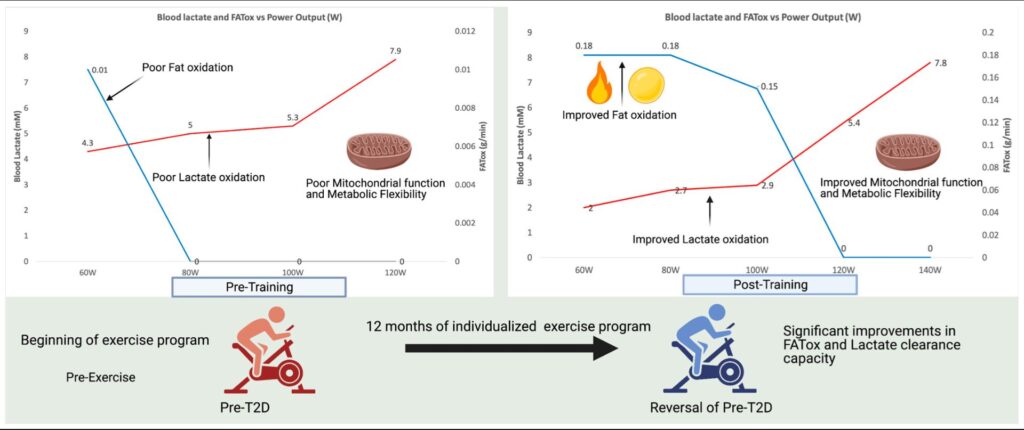
Exercise, the Only Known “Medicine” for Maintaining and Improving Mitochondrial function

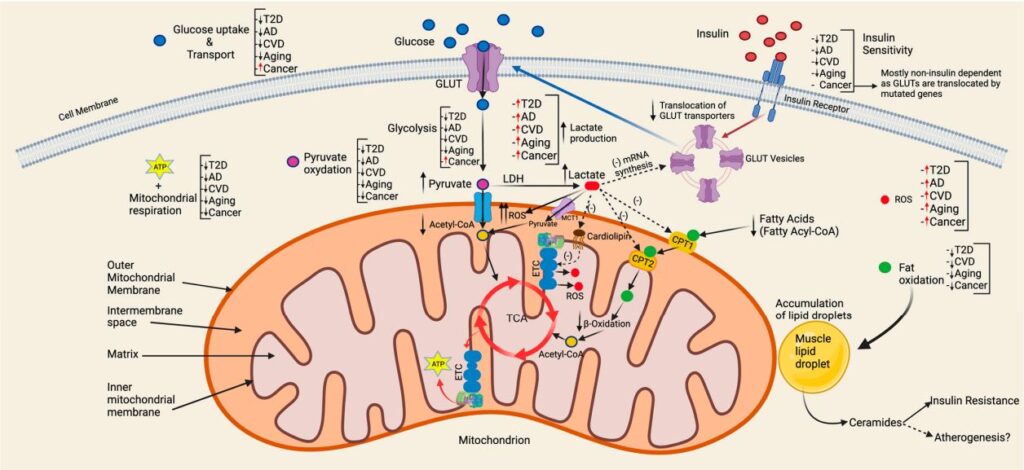
Mitochondrial health is key to health and disease Skeletal muscle plays an instrumental role in mitochondrial function in both health and disease as it is the most bioenergetically active organ with the highest mitochondrial content. mitochondrial dysfunction has traditionally been linked to type 2 diabetes, it is also a hallmark of multiple diseases, including cardiovascular

Exercise, the Only Known “Medicine” for Maintaining and Improving Mitochondrial function Read More »

The skeletal muscle lipid paradox, Type 3 diabetes and the lactate shuttle theory

Skeletal muscle lipid paradox – “A significant histological finding pertaining to skeletal fat metabolism occurs in physically fit individuals as well as in individuals with T2D, where both populations show an accumulation of intramuscular triglycerides. as both physically fit individuals as well as individuals with T2D are characterized by the presence of a “lipid droplet”

The skeletal muscle lipid paradox, Type 3 diabetes and the lactate shuttle theory Read More »

Notes on: The key role of mitochondrial function in health and disease part 9

Part 9. Welcome. I learned some neat stuff from reading this paper and I would like to share: Furthermore, mitochondrial dysfunction plays a significant role in cardiovascular diseases, affecting both heart and vascular tissues. The heart, which is highly oxidative, relies on mitochondrial oxidative phosphorylation for ATP production, primarily through fatty acid β-oxidation and aerobic

Notes on: The key role of mitochondrial function in health and disease part 9 Read More »

Notes on: The key role of mitochondrial function in health and disease part 7

Part 7. The lack of physical exercise can have deleterious effects on mitochondrial function. Physical inactivity has been associated with the following diseases: Low cardiorespiratory fitness is considered to be responsible for the highest percentage of all attributable fractions for all-cause mortality. No metric predicts risk for all-cause mortality better than VO2 max1. This study

Notes on: The key role of mitochondrial function in health and disease part 7 Read More »

Notes on: The key role of mitochondrial function in health and disease part 6

Part 6, this should be fun. Interestingly, mitochondria are the main producers of reactive oxygen species (ROS). ROS are necessary and involved in maintaining the following: With almost anything in biology, there is an optimal range of ROS concentration. Excess ROS production can be countered with antioxidants such as: If ROS production exceeds antioxidant capacity

Notes on: The key role of mitochondrial function in health and disease part 6 Read More »

Notes on: The key role of mitochondrial function in health and disease part 5

“Mitochondrial function is key in health and disease.” – Inigo San-Millan Part 5. Notes from this fantastic review paper by Inigo San-Millan. Okay I will attempt to summarize the bioenergetics of mitochondria and the krebs cycle. Fatty acids convert to Acyl-CoA. They then undergo β–oxidation and are converted to Acetyl-CoA for oxidation in the Krebs

Notes on: The key role of mitochondrial function in health and disease part 5 Read More »